On October 23, the Michigan State University (MSU) Museum hosted students from Everett, East Lansing, and Waverly High Schools as part of the Smithsonian’s National Museum of American History’s 2025 National Youth Summit. As the first Smithsonian Affiliate in Michigan, the MSU Museum joined institutions nationwide in a deep exploration of educational access and opportunity. This year’s Summit invited teens to consider the guiding question: “How can young people help create educational access and opportunity for all?”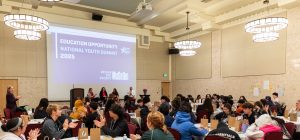
During the program, students explored the Smithsonian’s 2025 case study materials, which examined two pivotal moments of youth-led activism—the landmark Mendez v. Westminster court case (1946) and the Chicano student walkouts of the 1960s and 1970s. Through guided activities, small-group discussions, and hands-on reflection exercises, participants considered how young people have shaped civil rights movements and influenced educational change throughout U.S. history.
“The National Youth Summit creates a powerful space where students can engage with primary sources and create real-world action plans with their peers from other schools,” said Denice Blair, Director of Education at the MSU Museum. “The stories of Sylvia Mendez, the Chicano student activists (including some at MSU), and so many others remind us that young people have long been leaders in demanding access to education. It is inspiring to watch Michigan students connect past movements to the challenges and opportunities they see in their own schools today.”
As part of the Summit experience, the MSU Museum hosted a live panel featuring Michigan education and community leaders, moderated by WKAR reporter and MSU student Victoria Witke. Panelists included Amber Sheerin (Michigan Library Association), Dr. Estrella Torrez (MSU Residential College in the Arts and Humanities), and Dr. Kyle Greenwald (MSU College of Education). Together, they discussed educational access across rural, suburban, and urban districts; the impact of identity and representation in curriculum; and the influence of technology, digital access, and AI on student opportunity.
The National Youth Summit is organized annually by the Smithsonian’s National Museum of American History and is supported by the A. James and Alice B. Clark Foundation, the Patrick F. Taylor Foundation K–12 Learning Endowment, and the Smithsonian’s Together We Thrive initiative.